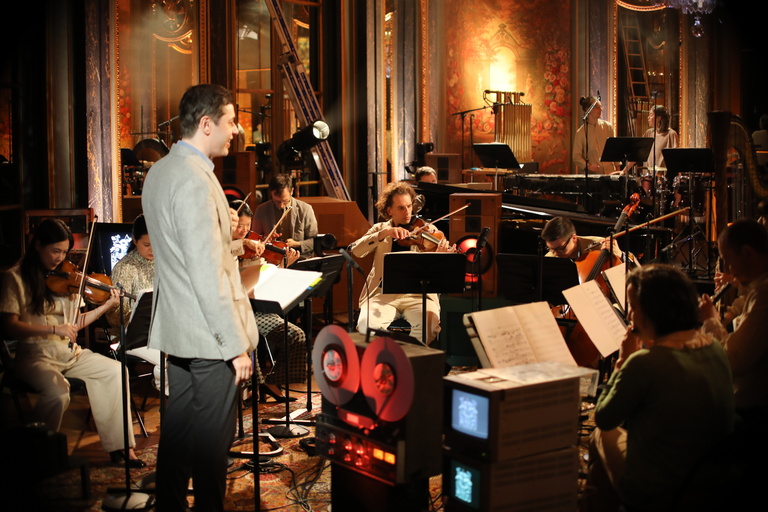
Interview with Maxime Pascal (by Manon Fabre, b·records)
How did the desire to take on Bhakti with your ensemble Le Balcon come about?
M. P. Bhakti is a work of great importance to me, which I discovered when I was a student at the Paris Conservatoire. I was so struck by it that I made it the subject of my analysis dissertation in Michaël Levinas's class. The first time I went to see this work performed in public, I had the feeling of attending not a simple concert but a ceremony; that impression has never left me, and the work has accompanied me throughout both my journey as a student and as a performer. Two things had particularly struck me: first, a very singular approach to time, shaped by Jonathan Harvey's encounter with Hinduism; and second, the question of sound and electronics, since Bhakti is a mixed work for instrumental ensemble and tape. When I founded Le Balcon, still as a student, with the idea of an amplified ensemble closely tied to electronics and amplification, this piece was among the works that guided the artistic direction of this new project.
Bhakti is an eminently spiritual work. What is specific about this spirituality within the repertoire carried by Le Balcon?
M. P. What is unexpected is that, from its very beginnings, Le Balcon spontaneously turned towards repertoires strongly marked by spirituality: Stockhausen, Harvey, Grisey, Feldman, Vivier… This is naturally tied to a generation of composers confronted with Eastern philosophies and ritual traditions that significantly transformed their relationship to musical time. In Jonathan Harvey, a deeply devout man attentive to different forms of spirituality, the question of electronics plays a decisive role in the relationship between music and spirituality. He is without doubt one of the composers who best articulated the link between electronic music and the spiritual dimension, conceiving of electronics as a music of the invisible: where instrumental music associates the sonic gesture with a visible presence, electronics, diffused through loudspeakers, removes the performer from sight. Harvey thus likens it to church organ music (one hears the organist playing from their loft, but cannot see them) and to the bell placed high in the bell tower, which one also hears without seeing. In doing so, he situates himself in the tradition of two other composers: Messiaen and Stockhausen, with their choirs of invisible angels found in Licht and Saint François d'Assise; Messiaen's passion for birdsong also speaks to a close bond between the invisible and the spiritual. Bhakti fits very clearly within this legacy.
How does this interplay between electronics and instruments translate concretely?
M. P. Since 2008, Le Balcon has been built around an expanded notion of the orchestra that incorporates the electronic dimension, comprising two aspects. In the conception of the electronic part of mixed works, the computer music designer plays a fundamental role alongside the composer. But the RIM also holds a role as performer of the electronic part during the performance itself, alongside the instrumentalists and singers. In my work as a conductor, I coordinate the ensemble like a chamber music group or an orchestra, with no hierarchy between electronic and instrumental music. What has changed greatly since the premiere of Bhakti in 1982 is that the sounds which were fixed on magnetic tape are now digitised and can be played from a computer. In the past, one pressed play and there was no room for manoeuvre; today, the tools and accumulated experience allow us to make this interpretation far more performative, in the sense that the electronics themselves are subject to genuine real-time interpretive work. We adapt the diffusion, dynamics, synchronisation, and intonation, so as to make the live and the pre-recorded breathe together.
The work unfolds across twelve movements, each associated with a hymn from the Rig-Veda, a sacred text thousands of years old. How do you perceive this journey for the listener and for the ensemble?
M. P. The hymns of the Rig-Veda are among the oldest texts to have come down to us. Harvey places the citations at the end of the movements, as Debussy placed the titles of his Préludes at the bottom of the page: the music is played, and only afterwards does one discover this text that seems to comment on what has just taken place, in a form of discreet distance. The chosen hymns are linked to transformation, to becoming, to the flow of time. Musically, the work alternates purely instrumental movements, purely electronic movements, and sections where "the two worlds merge in a theatre of transformations and sleight of hand […] as in a magic trick", to borrow Harvey's own words from his Thoughts on Music (L'Harmattan, 2007). The electronics then take on two faces: that of unheard-of synthesised sounds, marked by the world of bells and resonance, and that of an invisible orchestra, pre-recorded instruments acting as doubles of the instruments played live. The musicians thus sometimes find themselves playing alongside their own sonic mirror, in a play of reflections where the orchestra imitates the electronics and the electronics imitate the orchestra. In total, the twelve movements fragment into around fifty sections, like a kaleidoscope between visible and invisible, real and unreal, present and distant, all carried by a sensation of weightlessness and a fundamental ambiguity that Harvey explicitly sought.
Would you speak of a genuine dramaturgical arc, or rather a succession of tableaux?
M. P. It is above all a succession of moments, which can call to mind Stockhausen's concept of Momentform: a sequence of sonic tableaux that do not follow a linear narrative, but which succeed one another, sometimes through contrast, sometimes through gradual metamorphosis. One moves from one landscape to another, or the landscape transforms around us until we realise we have entered a different sonic world without having seen it coming. Silence often serves as a bridge between these worlds. The form itself proceeds from a combinatorial thinking of serial inspiration: twelve movements like twelve notes, an organisation based on systems of numbers and correspondences. Unlike "process"-based aesthetics such as those found in Grisey or Ligeti, the path is not the slow transformation of a material, but rather the articulation of a set of possibilities into a luxuriant form. The ear does not hear the series as such, but perceives this profusion of spaces that reveal and withdraw themselves in turn.
What were, for you and for the ensemble, the main technical challenges of this score?
M. P. The first challenge remains synchronisation with the electronics. Depending on the movement, two elements are particularly difficult to synchronise with the instruments: the electronic bell, which plays in a complex metre; and the pre-recorded orchestra (in this case the London Sinfonietta from Harvey's time) to be synchronised with the live orchestra without recourse to a metronome. The second challenge concerns the overall balance between instruments and electronics: the dynamics are notated very precisely by Jonathan Harvey, for each instrument but also for the electronic part. The challenge of the score is to harmonise the shared dynamics between, on the one hand, instruments whose timbres are of very heterogeneous natures and, on the other, the electronic sounds, which are by their very nature very different from an instrumental sound. This twofold degree of harmonisation is particularly complex to achieve in the moment of performance.
What does it mean to you to record Bhakti live?
M. P. The true challenge of this music is that it functions in situation: that the performers must bring the piece to life, must resolve these various questions of synchronisation and balance live, in front of an audience. Capturing that moment, rather than an ideal and abstract balance constructed outside of any performance, seems to me the most faithful way of conveying what this work carries within it: a sonic ceremony, a ritual atmosphere that allows for a shared experience of the invisible. For this work, then, a live recording was the only natural choice.
```