Bhakti

Jonathan Harvey
Bhakti (1982)
for Chamber Ensemble and Electronics
© 2025 - Fondation Singer Polignac / Festival Singer-Polignac
Bhakti, composed in 1982 by British composer Jonathan Harvey, is far more than a musical work: it is a ceremony. The Sanskrit word bhakti means devotion, the soul's impulse toward the divine, and it is precisely this atmosphere of ritual that the music seeks to conjure.
The work unfolds across twelve movements, each secretly linked to a hymn from the Rig-Veda, one of the oldest sacred texts in human history. Just as Debussy placed his titles at the bottom of the page after each Prélude, Harvey tucks these references at the end of each movement, a discreet commentary, discovered after the fact, that retrospectively illuminates what has just been heard.
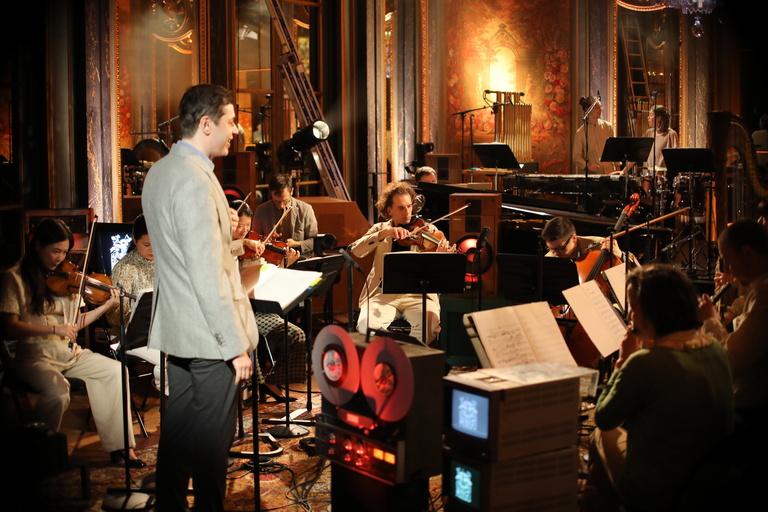
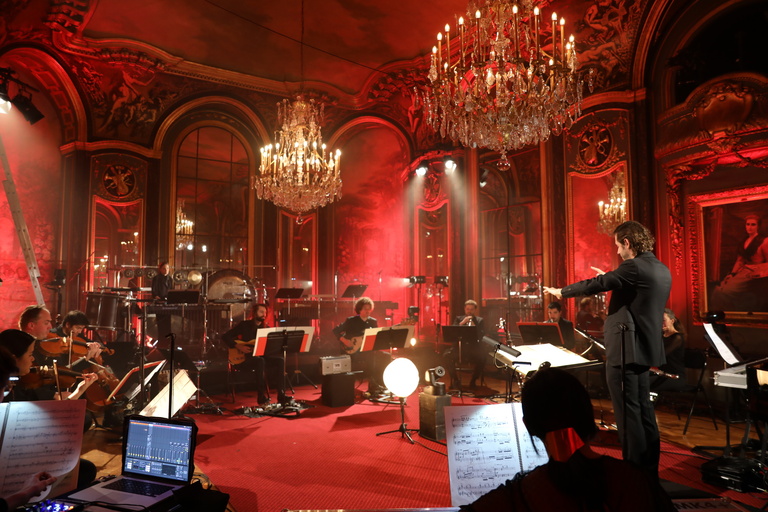
What strikes the listener immediately is the encounter between living, breathing musicians and electronic sounds diffused through space. Harvey conceived of electronics as an invisible music: like a church organ whose sound reaches us without our seeing the hands play, or a bell at the top of a steeple heard but never seen, the loudspeakers conjure a faceless sonic presence. The instrumentalists sometimes find themselves playing alongside their own pre-recorded doubles, in a game of mirrors between the real and the unreal, the present and the distant.
From one movement to the next, the listener travels between contrasting soundscapes, carried along by a sense of weightlessness. There is no story to follow; instead, one is swept through a succession of worlds, like the facets of a kaleidoscope, until it becomes difficult to tell what comes from the stage and what comes from the surrounding air.
Illustration © Claire Pedot

© Charlotte La Pietra / Fondation Singer-Polignac
© Charlotte La Pietra / Fondation Singer-Polignac
© Charlotte La Pietra / Fondation Singer-Polignac
© Charlotte La Pietra / Fondation Singer-Polignac
© Charlotte La Pietra / Fondation Singer-Polignac
© Charlotte La Pietra / Fondation Singer-Polignac
© Charlotte La Pietra / Fondation Singer-Polignac
© Charlotte La Pietra / Fondation Singer-Polignac
Maxime Pascal direction musicale/musical director
Claire Luquiens flûte/flute
Quentin d’Haussy hautbois/oboe
Iris Zerdoud clarinette/clarinet
Mayuko Tanaka clarinette basse/bass clarinet
Joël Lasry cor/horn
Noé Nillni trompette/trumpet
Geoffray Proye trombone
Alain Muller piano, glockenspiel
Laurence Meisterlin, Tristan Glairacq percussions
Amandine Coudry-Herlin harpe/harp
You Jung Han, Eun Joo Lee, Julia Sa-Rang Kim violon/violin
Vladimir Percevic alto/viola
Askar Ishangaliyev violoncelle/cello
Augustin Muller diffusion électronique/live electronics
Denis Lorrain, Jean-Baptiste Barrière, Stanley Haynes réalisation informatique musicale Ircam/Ircam computer music design
Fondation Singer-Polignac