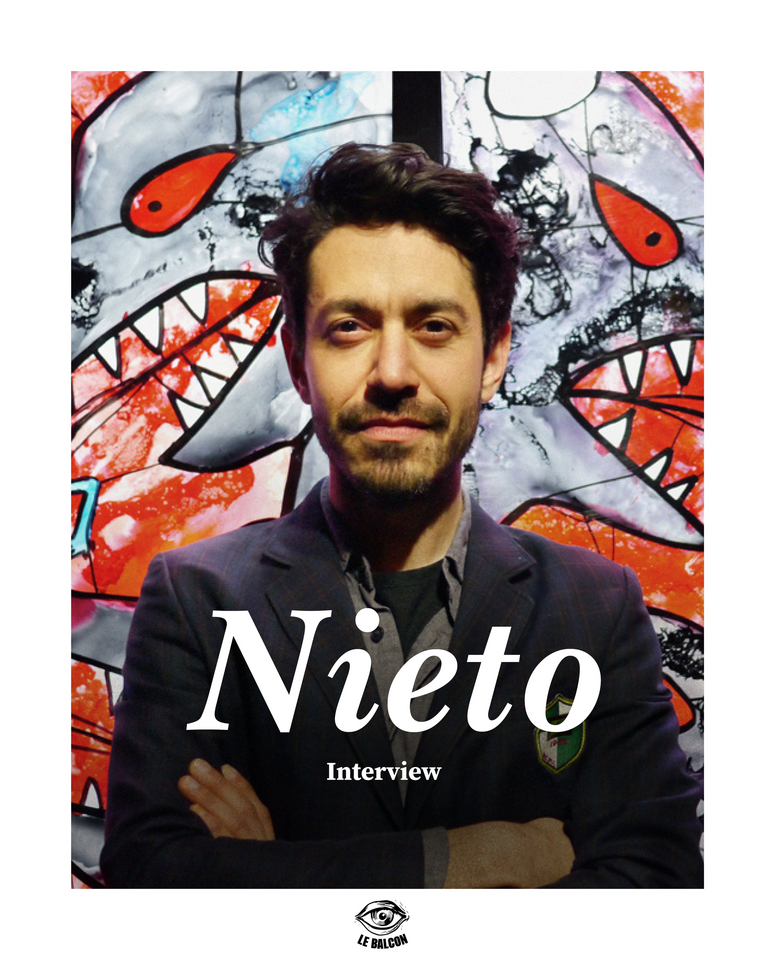
A Conversation With Nieto
Born in Colombia in 1979, based in Paris since 2002, expelled from the École Nationale Supérieure des Beaux-Arts of Paris in 2009, Nieto is a multidisciplinary artist. Painter, musician, video artist, he is also opera director with Le Balcon (La Métamorphose by Michael Levinas, Jakob Lenz by Wolfgang Rihm, Samstag aus Licht by Karlheinz Stockhausen). In Paris, he exhibits at the Da-End gallery. His work reveals a baroque and ironic world, where fiction, dark humour and visual tricks mingle. With the Stinky Films studio (Europe, Asia, Russia and South America) and Ghost Robet (United States), he has directed numerous commercials.
How did you end up in the music world?
Completely by chance, just like with art and video, because in Colombia, even though I always loved drawing, I studied linguistics and started working in advertising. I had a colleague ; he didn’t know how to play music, neither did I, and so we decided to start a rock band. We bought two guitars and then we started clowning around. We got in touch with a really bad drummer that nobody wanted, and we bought a bass drum and a snare. With that, we started rehearsing, but since we didn’t know how to play, we made stuff up with our voices, with recordings… I was recording onto a CD back then, with my Discman, I’d create loops. It got really experimental. Then we saw there was a rock band competition and we signed up. You had to play live shows so people would vote, so to throw them off, I’d come up with weird performances. In Colombia, there’s a whole clown culture: you hire clowns to come liven up kids’ parties. So I called one of those clowns and told him: « Listen, this isn’t a kids’ party, it’s a concert. We’re in a contest. How about I pay you, you come, and I give you a mic ». Because we never spoke to the audience. That was the main rule : we never said hello, thank you, goodbye, nothing. We’d show up, play our stuff.
© Meng Phu
And it was really weird because the tracks were short, strange, and people never knew when it was over, when it started. When they were applauding, we were already starting the second song, and after that we’d just take off without saying anything. I’d bring the clowns, give them a mic, and tell them to tell dirty jokes, mess with the audience between songs. And there was another buddy who was kind of in his own head, who loved dancing, so I’d tell him to dance while I played… He’d put down his mattress and pillow and sleep on stage. So yeah, it was very weird, people were a bit baffled. In the end, we won that contest. Against all the others who’d been spending their whole lives rehearsing for five years! It was kind of unfair, but hey, people liked the clownish, strange side of it that they weren’t used to.
So those were my first interactions with music, and that’s when I came to France afterwards. I went back to art school, first in Toulouse. Within a year, I’d graduated, then they told me to go to Paris, to enroll in art school there. So I came to Paris to do the Beaux-Arts and the Arts Décoratifs. And at the Arts Déco, for my final project, I was supposed to make an animated short because they’d been teaching us special effects. I refused and told them I’d rather play a joke on the jury. I brought a box and made them believe there was a real mouse inside, along with a camera in the box. So I put the mouse in, and you see the inside of the box behind me. I present the mouse, turn on the camera, put the mouse in the box, and I say « Now I’m going to cut it in two pieces! » They’re like, « What, how, that’s crazy! ». So I take a sheet of glass and the mouse is cut in two. Except after that, two mice come out! It’s a bit cartoon, but realistic. You really see there are two mice. After that, I take the second mouse, put it back, stick a straw in the other one, it inflates, gets enormous… And all live. But very quickly, obviously, you realize it’s all fake, that it’s all pre-recorded, that it’s all just theater. And I remember the head of my program wanted to film it. I was like, no, I don’t care, why would you film this? It was just a joke I wanted to play on the juries. But he set up a camera and filmed me doing it. And then the school submitted all its films, and since I didn’t have a short to present, they just submitted that recording. He entered it into short film festivals and it got picked up everywhere, won awards all over the world. It blew up. It was his film, not even mine, but festivals were calling me from everywhere to ask me to do a performance in front of an audience. I agreed on the condition I could do something else. So every time I went to a festival, I’d use the same principle, but with a completely different idea, where the audience would realize at the end that everything had been fake from the start.
I then started inventing fake characters, fake artists. I’d invented a fake art movement called « perversionism ». It was to make my art school professors believe there was an art movement in Latin America they didn’t know about. Since back then there wasn’t much internet, it was hard to check whether it existed or not. I remember I’d go to Libération, to their office at République, to ask them to give me blank paper, then I’d print on it with my inkjet printer. When you print on that paper, it looks like a real newspaper clipping. So I’d print fake stuff in Spanish, talking about « perversionism », and show it to them. They believed I’d gotten this stuff from the press and that it existed over there. And the idea of this movement was to do somewhat clandestine stuff, super trashy, to do illegal things to make art. And I met a buddy who’s my best friend now, Marcel Montes de Oca, a Mexican guy with very indigenous features, and when I saw him I told myself we had to make films with him. He’s the one I had play the role of one of these « perversionist » artists.
At some point, a gallery owner offers to exhibit my work at the Centquatre because there was an art fair there. I told him I didn’t have any artworks to exhibit but that he could find me a slot in the venue’s lecture program. I told him I was going to give a lecture on « perversionism » and he agreed. He found the slot, and at the end of the lecture, I announce that we have a live Skype connection with a « perversionist » artist in his studio, and we see Marcel with his indigenous friends. I’d made up this whole thing where first I interview him: so we see them on screen and he starts saying he makes his works with blood, bones, excrement, horrible stuff. And then he says, « I’m going to show you the latest piece I’m working on. ». I answer « No, no, no, it’s fine, we don’t want to see, we just wanted to talk » but he insists: « No, yes, yes, yes. No, no, it’s fine, I’m here. No, no, no, it’s okay ».
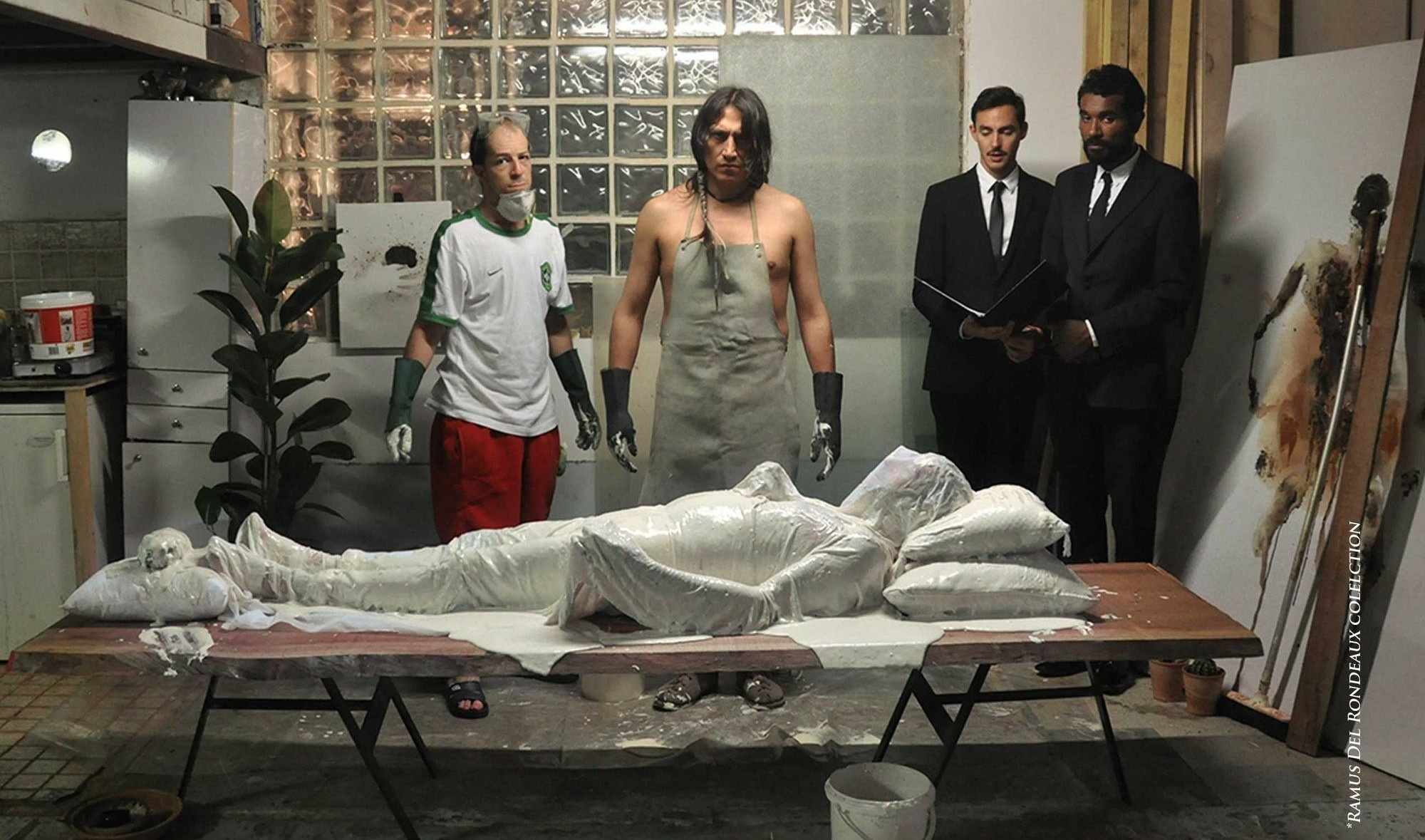
Marcel Flores & Ramus del Rondeaux - Video making of the sculpture "Ramus Velato" (2017)
Eventually, he takes off his headphones and I lose control over him. He grabs the camera, flips it around, and with his assistant they push a naked man onto a canvas. Then they turn him over and it’s a corpse cut in two! At that point, people are… Someone leaves to throw up. I immediately cut the connection and take off, I slip away, then I’m out and I leave people like that. The idea was that I’d already announced there would be a « perversionist » exhibition at the Kamchatka gallery, a week later. It was kind of a promo for it. And yeah, sure enough, afterwards there was the exhibition with the painting in question, which was on display there. I’d gone to buy blood at the butcher’s, ox blood, to make the real painting! Goths would come to see the canvas. I’d dress up as a priest. It was funny.
Were you doing all this for fun, or was there the idea of building some kind of reputation?
No, obviously, these are things I did just like that, to play jokes. To play the joke on the jury, the joke on the rock contest, the joke on the Centquatre, on the art world… But all of that made me think about art: about what art and the role of the artist are. What really interests me is the Middle Ages. And from the Renaissance onward, for me, it’s over. From the moment artists start signing their work or putting themselves forward. We’re no longer in the artwork, but in the artist’s reputation, in their market value. And for me, if I’m a collector, I want to buy this because I like it, because I have a culture and I can judge the visual quality of an artwork, and not simply: « Yeah, the artist is famous, it costs a lot, so I’ll buy it ». It’s really a nouveau riche bourgeois mentality with no education, but that’s the law of art.
So that’s all kind of what I’m questioning, and that’s why I try to create different artists, avatars. It allows me to have multiple worlds and to test completely different techniques and aesthetics. Whereas when you’re an artist and you’re recognized, you don’t have the right to do that. Because people recognize you and they say « Oh, that’s the guy who does the photorealistic paintings! » and so you’re going to do only that your whole life. You can’t step out of that box because otherwise they’re not going to sell.
Do all your avatars have a different philosophy?
I try to make sure they have different aesthetics and different lives. For example, I invented this fake Japanese artist, Daïchi Mori, who lives shut up in his room. A gallery owner, from the Da-End gallery, discovered me when I was making the little videos with the mice, with « perversionism ». That’s when she contacted me to come to the gallery. When she offered me a solo show, I said « Oh great, I’m going to do painting! ». She said « No, you’re the gallery’s video artist, you have to do video ». I was like, « Damn, that’s not possible, I want to do painting! ». And that’s when I came up with the idea of inventing a fake painter to do a « duo » show. My gallery owner loved the concept and she put me on the trail of a Japanese artist. It was the France/Japan year, and on top of that one of the two gallery owners was Japanese. As we say back home, « It fell like a stone in a one-eyed man’s eye », and that way everyone was happy. The painter was this Japanese avatar that let me make Japanese-style paintings on long scrolls. I’d go through Google Translate and copy the characters.
It was funny because while preparing the opening, I thought, « Oh shit, people are going to come and wonder, but where’s the other artist? The Japanese artist, why isn’t he here? ». The day before the opening, I told myself I was going to make a little documentary about him. I went on Japanese YouTube and typed « grandmother » in Japanese. I found tons of videos of old ladies speaking Japanese, and I subtitled whatever. So my artist ended up with a little documentary featuring old ladies talking. And I’d explain, « Oh yeah, this is the old lady whose grandson lives shut up in his room, Hikikomori-style. That’s why he’s not here. ». So I started fueling this whole fiction about him, about the Hikikomori who shuts himself in his room and makes his artworks only for himself. He doesn’t want to show them. He doesn’t want to exhibit.
That’s when I realized there was another question about art, precisely: what is an artist? Artistic creation, as Kafka said, is something intimate. He didn’t really want to publish his works. It was after his death that his friends said, « No, but this is still brilliant, it’s a heritage of humanity, it has to be known and read by everyone ». But he, he didn’t want that. It’s crazy because all the rest of us artists, right away, when we make something, we want to post it, show it, exhibit it, get everyone to like it. Whereas he, in that fiction, would be completely the opposite. He makes his paintings just for himself. It’s really too weird!
How did your collaboration with Le Balcon begin?
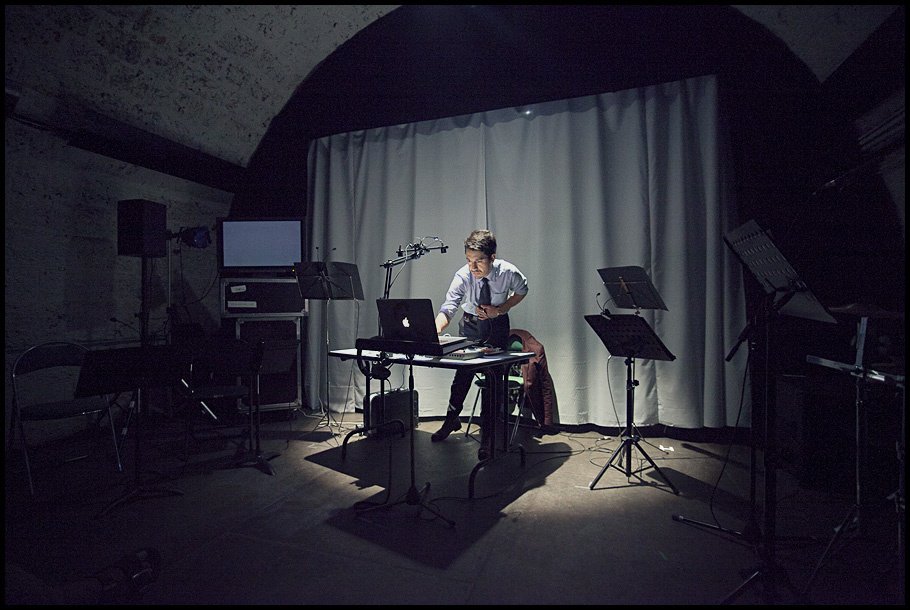
There was a whole generation of Colombian composers at the Paris Conservatory. It was also the era of Maxime [Pascal], Florent [Derex], Iris [Zerdoud]. And when they founded Le Balcon, there were two Colombian composers, Pedro [García Velásquez] and Juan Pablo [Carreño], who were part of the group. And in parallel, a bit on the side, there’s Marco Suárez [Cifuentes]. So through these Colombian connections, I ended up meeting Pedro and Maxime, who had seen my work and got in touch with me. Pedro asked me if I’d like to do something for opera. I was like: « I know absolutely nothing about opera, but yeah, totally! ». And so there were these first concerts to do, in 2012, composed by Pedro and Marco and conducted by Maxime. It was in the 13th, there were these basements with vaults where they organized events. There were three completely separate vaults and it was cool because they were parallel concerts: Maxime conducted the three concerts with cameras and people would move around. First you’d see one part, then you’d move and go into another vault to see another part, and Maxime was conducting all three. Since there were three vaults, I did a performance with dead mice. I did my music, I mixed, and it was really funny because people were coming to see something serious, contemporary music. I pretended I was playing a little piano that triggered electric shocks and made the dead mice scream at different pitches. But it was all theater, it was all pre-recorded. Pedro had made that music. It was funny because there was this audience that came to see a real music concert, they’d move from one vault to another, see Pedro’s stuff, Marco’s, before coming to see me. And I remember someone reported a conversation between two old people to me: « Who’s Le Balcon? » ; « They’re sponsored by Boulez » ; « Oh, okay then! ». Always the name of the artist.
I really liked that experience because I love, as an artist, being able to change scenes, meet people, other authors, other people with other worlds and other ways of seeing the world. To think about the world through music and not just end up with visual arts people, because that’s only visual. Or only with film people, because that’s another world. And those worlds, it’s hard to get them to cross over. It’s rare to be able to pull people from one scene to another, so every time I do a staging I try to bring in someone from film, someone from the art world. Because it enriches things to work with composers, I love that. I think it’s the highest art, actually. Music in general, performers… Because it’s the most immediate relationship to art, and it’s what elevates man in a very immediate way toward something higher. For me it’s the piccolo, it’s really the most… It’s nothing, it’s just breath becoming harmony. It’s like drawing; that’s why I love pure pencil drawing so much, because it’s the same thing, it’s a bit of charcoal at your fingertips, and with that, an artwork comes out. I find that crazy. There aren’t all the filters like in video where you need to prepare things; where you have many steps that make you lose the immediate artistic gesture.
Why then move toward opera, which requires a lot of staging and preparation work?
Yeah, opera is exactly like a feature film. But somehow, what’s interesting is precisely that, it’s that it’s no longer one artist’s work but that of many artists who come together to present a much bigger artwork. It’s a group thing, not a single vision. We follow a composer’s vision, just like in film we follow the director’s vision, but it’s not their work. In the end, that work and that vision are at the mercy of what the others are going to bring. And obviously, in a written piece of music, whether you have a completely crazy performer or a very academic one, that’s going to influence what the work becomes.
When you work as a director, do you try to communicate your own feeling, or do you rather try to understand and literally execute the composer’s vision?
It’s complicated. It depends on the composer. I worked with [Michaël] Levinas, for example, and I loved it because he’s out there and he has an abstract way of speaking. So I listen to him and I’m attentive to everything. You have to be, I imagine, listening to the composer because it’s their thing. Except that I’m also there because I have a visual vision on the dramaturgical stuff, on the staging. I also have to take the performers into account based on what they can do, or what they want to do, or their talent as actors… For example, people like Rodrigo [Ferreira], or Élise [Chauvin], or Vincent [Vantyghem], the singers in La Métamorphose, have completely different personalities. They have the technique and the vocal mastery, but they have ways of moving and playing a role visually that are completely different. So I’ll see how I can channel them or use their qualities to highlight them. I have a very precise vision upstream, but one I then have to constantly adapt to what the composer wants, to what he says, because he’s the one who knows the piece. Maxime has the understanding of the piece and he’s the one who can translate between the composer who is completely abstract to me, the score that I can’t even read, and translate it for me in terms of messages, symbolism, story; explain to me where it comes from, why we manage to do that, and what the composer wanted to say. So I try to soak all that up to imagine something. And then obviously, also have fun, do what I want.
Does it change a lot, the projects where you’re the video artist rather than the director? Does the approach or the dynamic change?
It’s completely different because there’s a hierarchy, which I value. I prefer working with a clear hierarchy, because otherwise you get lost and in the end it doesn’t look like anything if everyone gives their opinion. When I find myself in the director’s seat, then yes, I’m the one who decides. I like having soldiers, and among them, seeing that this one is the strongest, and telling him « You, you’re great at doing this. Go for it, enjoy yourself with what you know how to do ». I’m not going to try to constrain him. But when I find myself in the soldier’s place, I execute, « Yes, what does the colonel want? ». I’m not going to slow things down trying to impose my vision. Even if at the end, I’m the one making it, so my vision will inevitably end up in there, in the making of things. For example with Silvia [Costa], on Montag aus Licht, it was very clear. She’s the one with the aesthetic vision of her show, so I tried to adapt as best I could to what she wanted, without trying to impose myself too much. On Montag, I tried as much as possible to adapt to her world. But still, yeah, I have the constraint of my own aesthetic that inevitably ends up a bit in the show, despite her, despite me.
Given that you like playing with multiple identities, do you have an « identity » crafted for Le Balcon or for the operas? Do you intentionally try to create another style for Le Balcon?
No, meaning that I don’t try to create that identity, it’s just by the fatality of my means that I manage to do what I’ve been able to do, and it ends up resembling itself. It’s also because I’m in the research of video projections, projecting onto tulle, precisely to break that « screen » side, that just « video » side. What’s always bothered me about video is when, in a show, they impose a video on you that has nothing to do with what you’re watching and that only distracts or fills space. So I try as much as possible to integrate it into the show. In La Métamorphose for example, there were tons of moments when the actors and singers were « playing » with the video. At one point, Rodrigo, the one who plays the cockroach, walks on all fours, jumps, then disappears behind the screen. But after, you see him on the screen and he climbs up it. And when he disappears, the father, who’s whipping the singer, keeps whipping the same character but on the video. It’s really that kind of play I try to set up; to make the video part of the work, so that it’s not just a video artist who comes in and slaps his thing on top.
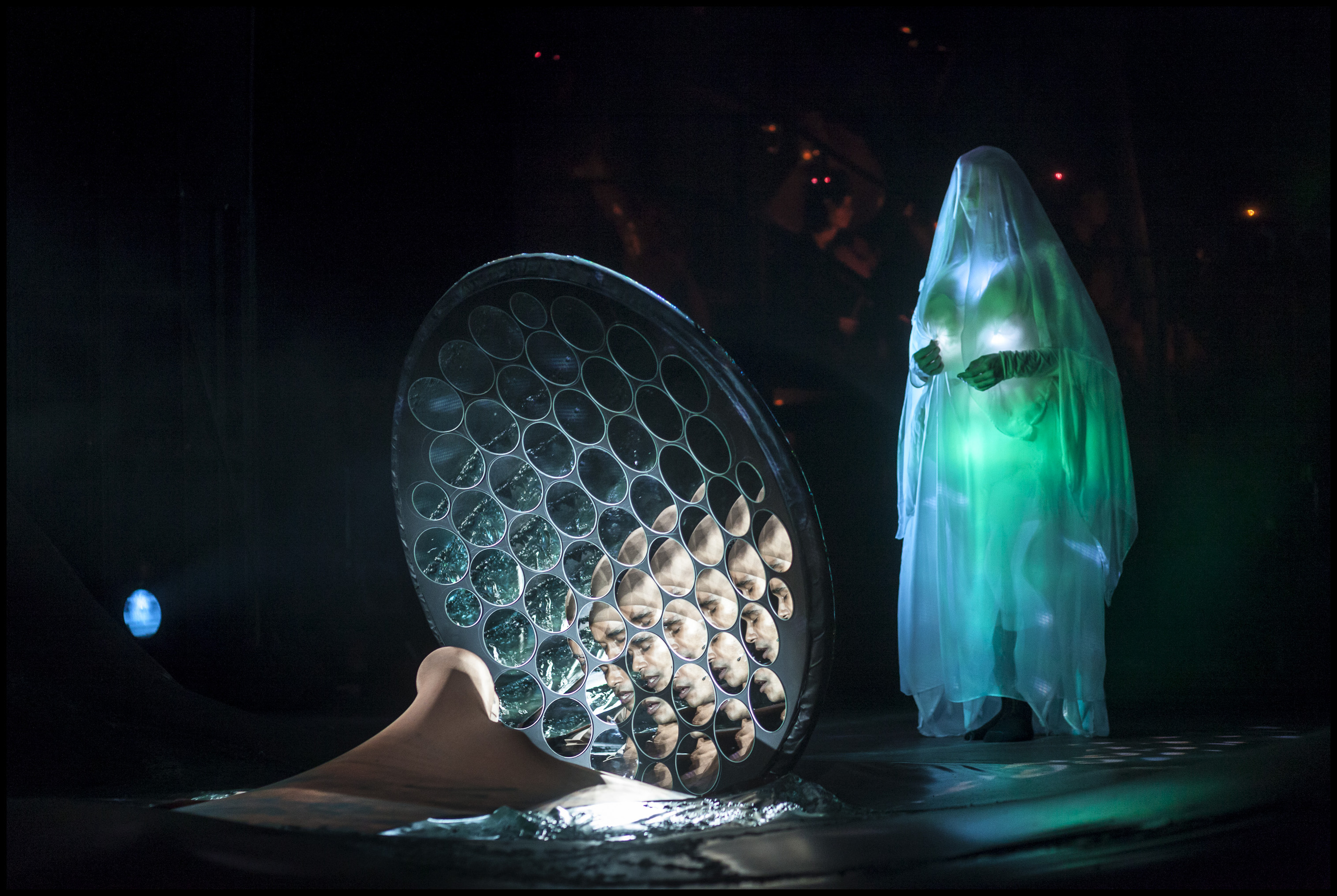
La Métamorphose (2015) © Meng Phu
With Marco Suárez Cifuentes and Le Balcon, you created the opera Revelo, which plunges us into an atmosphere that is, to say the least, anxiety-inducing, apocalyptic. Why are you drawn to these dark themes?
Like I was saying, I’m really into everything Middle Ages. I was reading the Apocalypse of Saint John, and that book is wild but it’s like an acid trip, because it’s Saint John describing his visions. He was locked up on an island, imprisoned, and I don’t know what mushroom he ate there, but he wrote the whole Apocalypse, where he had the revelation of Apocalypse, of the end of the world, but seen in a positive way, like some kind of last judgments in which there’s a renewal. And I came across these books with all those images. I told Marco: « Come on, we’re going to do an opera about this because visually, it’s insane ». And I started writing the libretto.
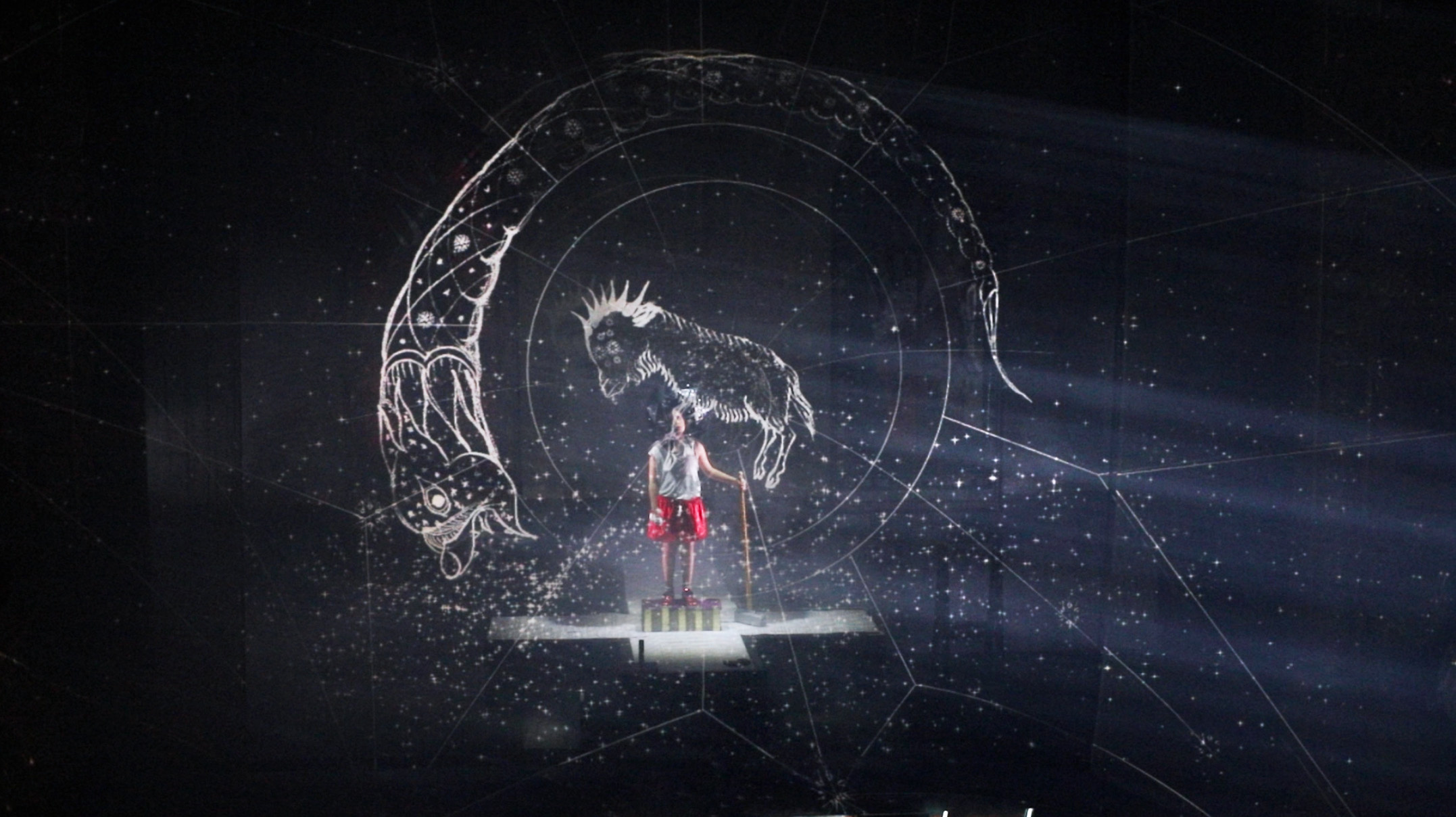
L’Agneau Mystique - Revelo IV (2019) © Camilo Osorio Suarez
To write the libretto, I did it like a collage, lots of links with things I’m reading, like Farid al-Din Attar, Lord Byron. I took bits of dialogue that I then adapted, I had all these characters converse. It produced crazy stuff because, in the end, you realize that everyone is talking about the same thing, that no matter the geography, the era, we’re all haunted by this idea of the dead, of the fatality of things and the absurdity of life, of banality. « But what are we doing here? » Also pretty much the idea from Nietzsche who said to himself, because we have this tendency to get depressed, the moment you ask yourself that question, it’s total depression because you say to yourself, « Yeah, what the hell am I doing here, and why is it so absurd to have a life like this and then die. And before and after, what’s happening, what happened? And what am I going to do with this stretch of time? Am I going to, I don’t know, work in a bank, or have fun, or shoot myself, or enjoy life? » These are kind of all the questions that lead me toward these nihilistic vertigos, which we dress up as amusement. Because in the end, that’s it, it’s that question that’s so heavy. But I still try to have fun with it, that’s why there’s always a bit of humor and it’s ultimately always a bit light, even when it’s very heavy. The joy of misery, I call it.
You’ve staged two operas from Licht and worked as a visual artist on others. Did you already feel connected to Stockhausen’s work before your collaboration with Le Balcon?
It was Maxime who suggested it. We worked with Damien Bigourdan and we did Dienstag and Samstag together. And yeah, it’s mostly Le Balcon that puts the teams together based on the works, because they see that in terms of narrative and in relation to what the piece is about, it would be good to have this or that person. So they’re the ones who organize the teams a bit.
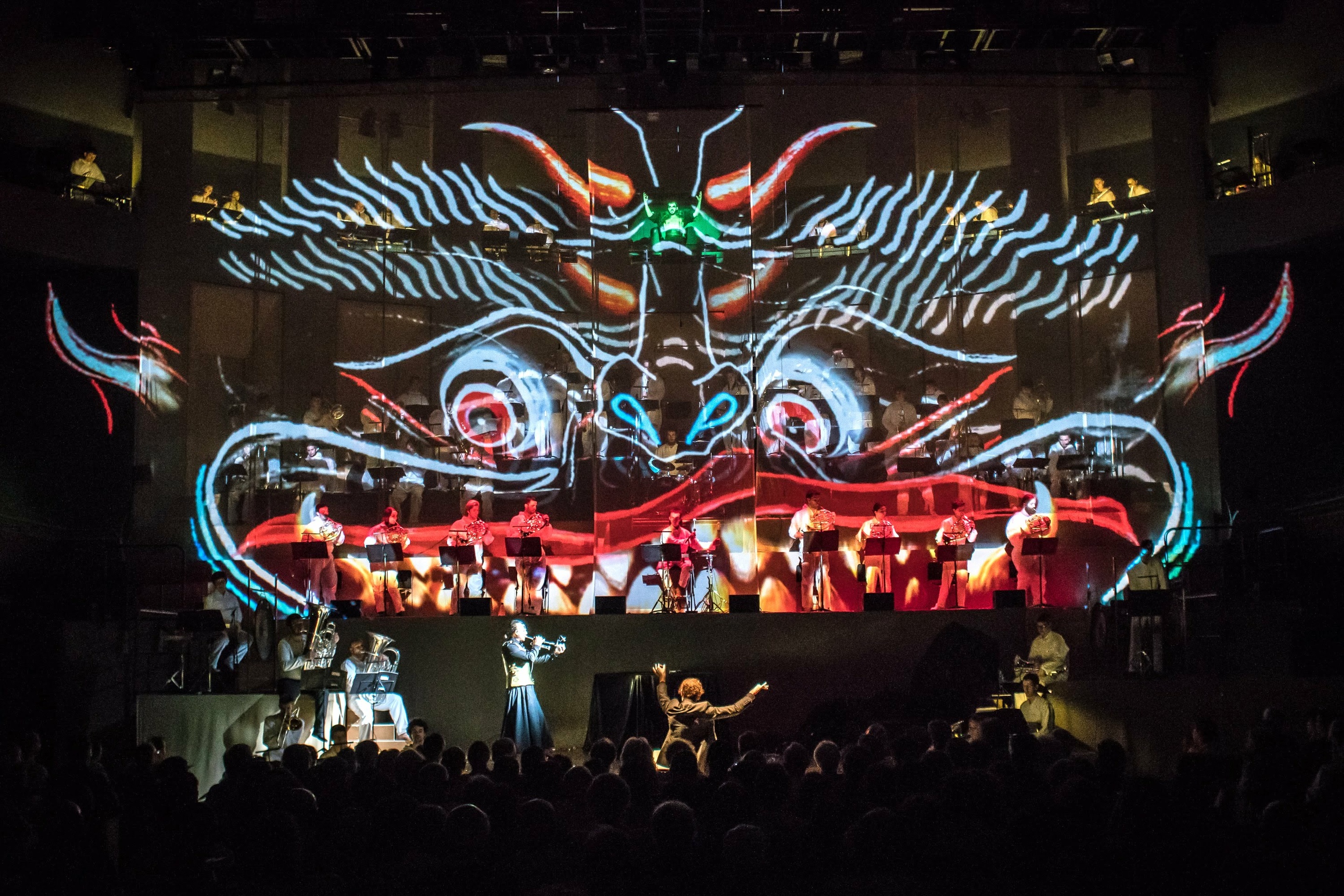
Samstag aus Licht at the Philharmonie de Paris (2019) © Meng Phu
I didn’t know Licht at all and I think I still don’t understand it, but I try. Every time Maxime sends me something, when he tells me to listen to something, I do the work, I put it on my little speakers, and there it’s like… « Ugh, damn, what is this? I don’t understand anything! » Well, after that, Maxime explains it to me. It’s the opposite of popular music for me. When you listen to a pop song, you listen to it once, you find it great, you listen to it every day, and after a while it becomes a nightmare. With written music, it’s the opposite. The first time you listen to it, it’s a nightmare, but the more you get into it, the more you say « Oh yeah damn, actually it’s brilliant, but it’s a crazy thing! » and when you see it live it all makes sense. Because when you listen to it, even with the best headphones, you don’t realize that the person thought about having trombonists up there, at the four cardinal points of the hall, with a chorus of young girls coming down the steps, with the trumpeters arriving here, fighting with the other one… And then you’re like, « Of course, I hadn’t seen or heard any of that ». It all makes sense and you can’t get any crazier. That’s when you say to yourself « Thank god I was part of this ».
I actually think that the more time goes on, the more I think that’s the future: live performance. Because with all the AI and all that stuff… I see that even me, being a video artist, when I open YouTube, there are tons of little windows offering me videos to watch. Always insane stuff. You click on it, you’ve got a monkey that… a vulture arrives, it climbs onto the vulture, takes off flying, and everyone’s like « whoa! ». But it’s AI, actually. Now, everything is AI. And so you lose interest. I’ve lost interest in watching that now. Sure, it’s crazy stuff, but the fact that it’s made by a robot ; you have this kind of romantic idea that nobody is making it anymore. So I tell myself that we’re all inevitably going to get so uninterested in all this digital stuff that we’re going to turn toward live performance. So what am I going to do? Well yeah, I’m going to go see a bullfighter standing before his bull. There, for sure he’s not lying to me and there will only be that single moment to see one of the two die, just for our bliss. And it’s amazing! We’re all in this same connection. Live performance is too beautiful for that, because it happens right there. At that moment, you’re completely disconnected from the world, from all those wars, from all those horrible things happening outside. And we’re all elevated toward something that pulls us a bit out of our human condition.
And yet, AI, which could be considered the height of fakery in the cases you were talking about, doesn’t it kind of make sense within your work?
Yes, yes, completely. And I use it a lot. But it’s true that I have a… I don’t know. To start with, video, I’ve never really enjoyed doing it. Like I said, what I prefer is drawing, really going to the source, what’s the noblest, the most immediate. But inevitably, I have a facility for video. I do it fast and I try to do it well. I was an ad director, I did a lot of advertising so I have a lot of experience in the field of video, of directing in general. Even in making animation or compositing, filming someone and then doing special effects… But it’s not what I prefer to do. It’s just that everyone calls me to do that because it’s inevitably… it’s what I do best apparently, so… And the most beautiful drawings, the ones you see in my videos, are made by my girlfriend [Claire Pedot]!
How do you stage operas as meticulously detailed as those of Licht? Do you have fun as a director?
I realized that with Stockhausen, you just have to follow as closely as possible what he says. And then, it works. When you start doing something else, it doesn’t work anymore. What’s clear is that he had such a precise vision, so strong, that if you try to stick as much as possible to all the indications he made, it works incredibly well.
I like it as a spectator, but to stage I don’t find it fun. No, it’s very… it’s very enriching and you learn a lot, which is precious because we don’t often get the chance to have requests this precise and a vision this strong and effective. You realize that if you can have humility as an artist and just execute the things that work, that’s when you’re in the service of this overall work that’s going to work. Because you didn’t try to put yourself forward, there isn’t someone who came in trying to add themselves to something that’s already so great. Yeah, because Stockhausen was a director, he left all those indications, so you just have to execute, and then the thing is killer.
But we do still notice touches of novelty in your stagings, like in Dienstag with those blood pouches that symbolize the passing of time?
Yeah, because there are inevitably things that aren’t written. And there are pieces that are more or less detailed, right? Some things are very detailed, like precise lighting, lighting designs, colors, while there are other parts where nothing is written, like in that race through the years with Damien where we had to improvise.
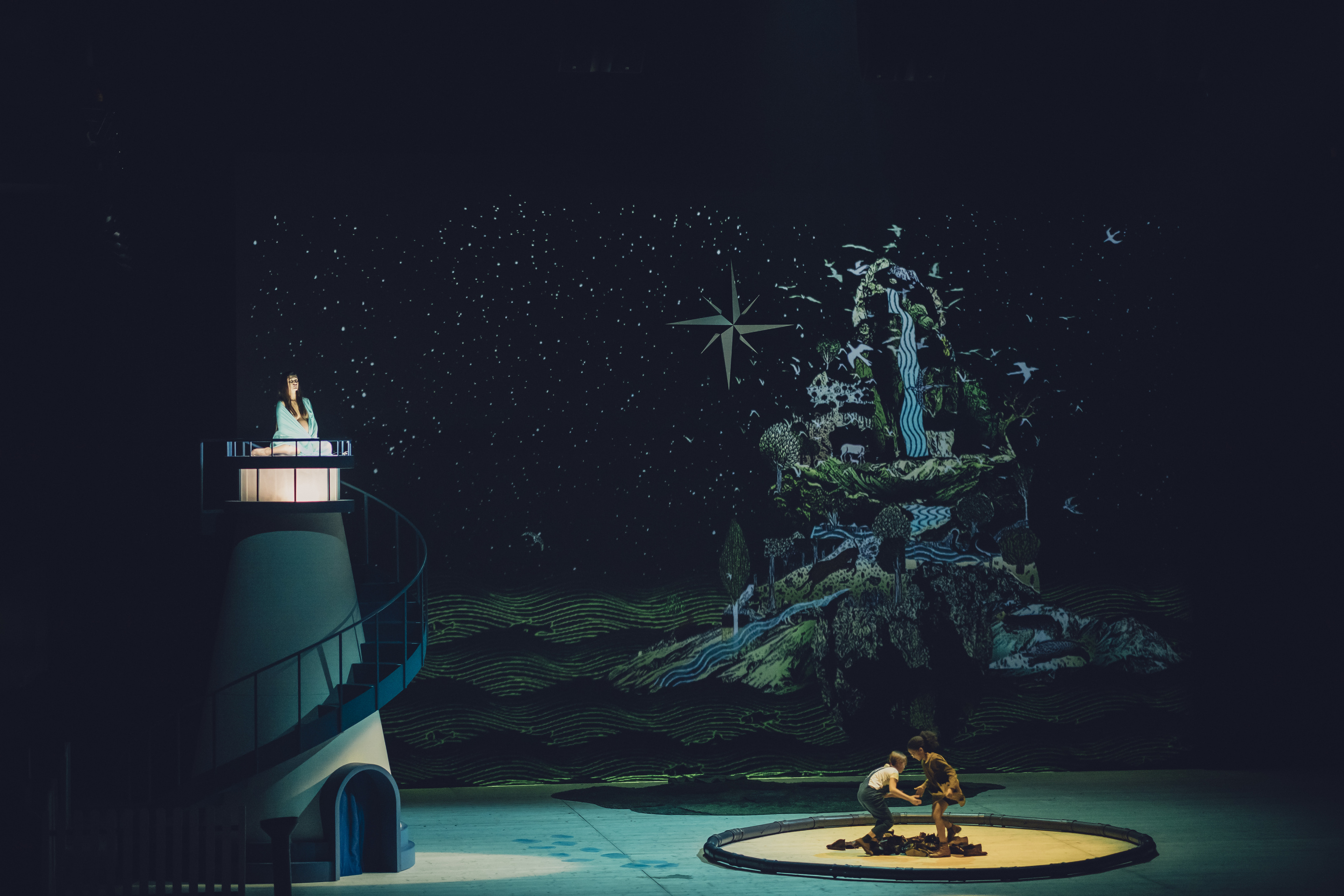
Montag aus Licht (2025) © Denis Allard
Interview: Zoé Misischi